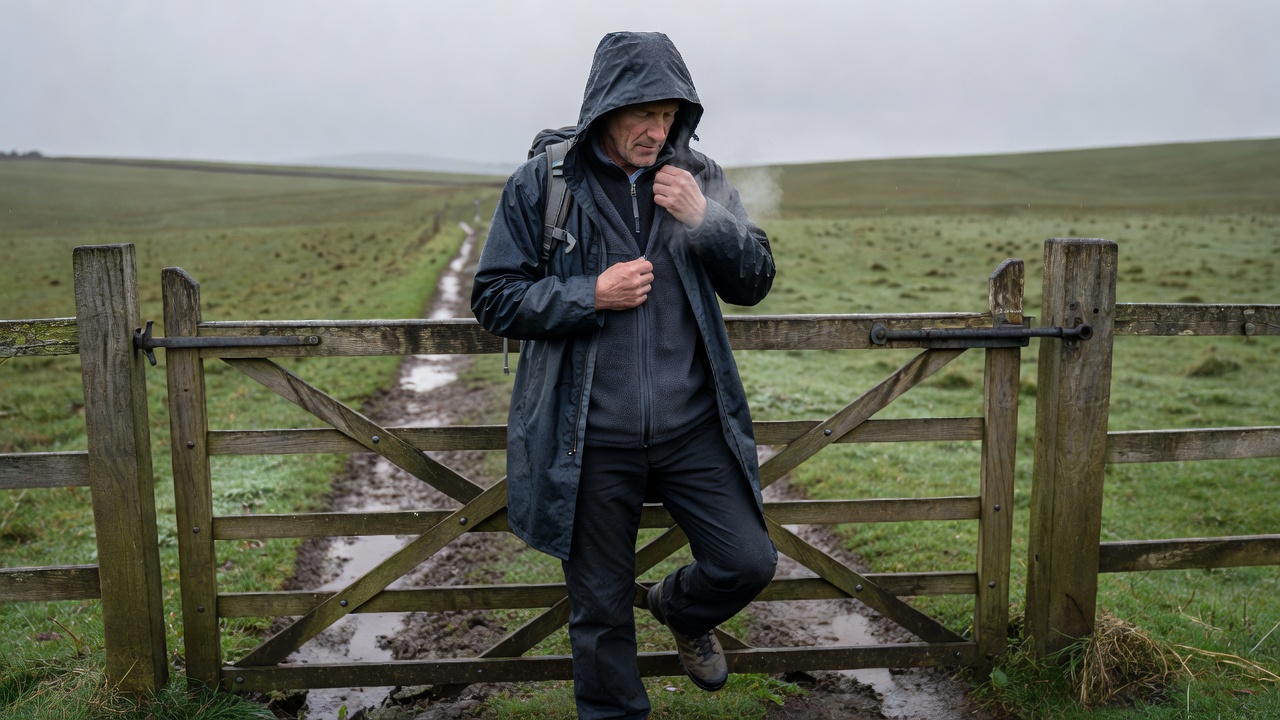
Layering gets explained as a system, which makes it sound more technical than it is. In practice it is a habit: wearing a few thinner garments instead of one thick one so you can add or remove warmth as the route changes. The trouble starts when layers pile up without a clear job. Two fleeces and a puffy jacket on a mild towpath walk is not a system, it is a sauna.
A useful test is to ask each garment one question before you leave the house: what is this layer for today? If you cannot answer, it can probably stay at home, or ride in the bag.
The three jobs, plainly
Outdoor clothing writers have used the base, mid and outer layer model for decades, and it still holds up because it describes jobs rather than products. Any garment can fill a role if it does the job reasonably well.
Base: moving sweat
The layer against your skin. Its main job is to stay comfortable when damp and to let moisture move away rather than sitting cold on your back. Merino wool and synthetic tees are common choices; a cotton T-shirt is fine for a dry stroll but tends to stay wet once soaked.
Mid: holding warmth
Fleece, a wool jumper, a light synthetic-fill jacket or an overshirt. This layer traps air. It is the one you take off most often, so it should be easy to stuff into a bag and quick to pull back on at a viewpoint.
Outer: meeting weather
The shell that deals with wind and rain. It might be a fully waterproof jacket, a windproof smock or a waxed cotton coat. Its job is protection, not warmth, which is why a thin shell over a fleece often beats a single heavy coat.
Spare: the stop layer
The piece you only wear when you stand still: a packable insulated jacket or an extra jumper. On walks with long pauses, such as birdwatching or waiting for children, this layer matters more than anything else in the bag.
Match the layers to the rhythm of the route
The same weather can call for very different clothes depending on how the walk moves. A steady flat route along the Thames Path generates even, modest heat. A loop in the Peak District that climbs Mam Tor and then drops into an exposed saddle swings between sweaty and chilly within twenty minutes. A city park walk with a café stop involves a long cold sit in the middle.
For steady routes, fewer layers usually work: a base, a light mid and a shell in the bag. For climbing routes, start slightly cool, because the first hill will warm you, and keep the mid layer accessible rather than buried. For stop-start routes, think about the stop first; the spare layer is what keeps a pleasant break from turning into a hurried one.
Zips, vents and the art of not undressing
Removing a layer is not the only way to cool down. A half-zip base layer, a full-zip fleece or a shell with pit zips lets you dump heat without stopping. When comparing two similar garments, the one with a longer front zip is often the more versatile, because it gives you a wider temperature range before you have to take it off.
Cuffs matter too. Pushing sleeves up is a quick vent, and it only works if the cuffs are not tight elastic. Adjustable tab cuffs on a shell let you open the wrists on a climb and close them when rain comes in sideways.
Everyday clothes that already layer well
You do not need a dedicated outdoor wardrobe to layer sensibly. A thin wool jumper over a long-sleeved synthetic sports top, under a plain rain jacket, covers a lot of British, Irish and northern European weather. A flannel overshirt works as a mid layer on dry days. A gilet keeps the core warm while leaving arms free for scrambling over stiles or carrying a toddler.
What tends not to work is heavy cotton as the middle layer on wet days. A thick cotton hoodie absorbs water and dries slowly, so once rain gets past the shell, it stays heavy for the rest of the walk.
When fewer layers are better
Every extra layer adds bulk at the shoulders and friction at the elbows. On short, familiar routes in settled weather, one well-chosen mid layer and a shell may be all you need. Over-layering is common and easy to spot: someone carrying a jacket in their hand for the whole walk. That jacket was doing nothing except making the arm tired.
A note on scope: this guide is about comfort on everyday routes. For high, remote or winter mountain terrain, follow guidance from organisations such as Mountaineering Scotland, the British Mountaineering Council or your local mountain rescue team, and check a reliable forecast such as the Met Office mountain forecast.
A simple pre-walk check
Before you step out, run through four quick questions. How long will I be moving, and how long standing still? Is there a climb? What is the wind doing, not just the temperature? Where will I put a layer once I take it off? If the last answer is "nowhere," choose a mid layer that packs small or ties around the waist without dragging.
Next, read about the materials behind each role in our fabric trade-offs guide, or see how garment details change the way layers work together.